.png)

March 7, 2025
Belt Conveyor Guarding Supports Charlee’s Run with $1,500 Donation
Belt Conveyor Guarding proudly donated $1,500 to Charlee’s Run in support of its community initiatives and impact.
Read More


.png)
Belt Conveyor Guarding

September 23, 2026
Every fixed ladder is a route to somewhere most people should not go. Silo tops, equipment decks, hopper platforms, roof access, mezzanines above running machinery. The ladder itself is usually well built and well maintained. The problem is that it stands in the open, and anyone can climb it.
Ladder guards answer that specific problem. They are barriers that restrict access to ladders by unauthorized operators, and they address a question that signage and policy alone cannot: not whether someone should climb, but whether they physically can.
This guide covers why unsecured fixed ladder access is a liability exposure, what a ladder guard does and does not do, what regulations actually say, and how to specify and install one.
The people a ladder guard is designed for are usually not the ones you planned for.
A contractor unfamiliar with the site. A new hire taking a shortcut. A delivery driver looking for someone. A visitor who wandered past the line. In some facilities, a trespasser after hours. None of them have the training, the authorization, or the awareness of what is running at the top.
The exposure is broader than the climb. What sits above a fixed ladder is often the reason access is controlled in the first place: rotating equipment, process piping, confined space entry points, energized systems, or a work platform designed for trained personnel following a specific procedure. Unauthorized access to that area is a hazard exposure and a liability question at the same time.
The cost of getting it wrong is not abstract. The National Safety Council puts the average cost of a single medically consulted work injury at $48,000, and a work-related death at $1.54 million (NSC, Injury Facts). Against those figures, a physical barrier on a ladder is one of the least expensive access controls a facility can install.
There is also the question of what a facility can demonstrate after an incident. A documented, physical restriction on access is a materially different position than a sign and a policy that someone was expected to have read.
A ladder guard is a panel that mounts over the lower section of a fixed ladder, covering the rungs a person would need to start the climb. It restricts access to the ladder by unauthorized operators. That is the entire function, and it is worth stating plainly because ladder guards are frequently confused with equipment that does something else.
A ladder guard is not fall protection. It has nothing to do with fall arrest systems, cages, harnesses, anchor points, or anything else that protects a person who is already climbing. Those are separate systems addressing a separate hazard, and a ladder guard neither replaces nor supplements them.
A ladder guard is an access control device. It works on the same logic as a locked door: it does not make the space behind it safe, it makes the space behind it reachable only by the people who are supposed to reach it.
BCG AccessGuard Ladder Guards are universal, ergonomically friendly guards designed for exactly that purpose. Standard size fits most applications, with custom sizes available upon request.
No, a ladder guard is not automatically required simply because a ladder exists. Whether guarding is needed depends on the specific ladder, its location, access to a hazard, and the applicable safety considerations.
Regulations do not mandate ladder guards. OSHA’s fixed ladder requirements at 29 CFR 1910.23 govern the design, construction, and condition of the ladder itself — rung spacing, clearances, structural capacity, maintenance. They do not require a barrier restricting who may climb it. Canadian provincial regulations and CSA standards similarly address ladder design and safe use rather than mandating access restriction hardware.
A ladder guard is a control a facility chooses to install because unauthorized access to what is above the ladder represents a risk it has decided to eliminate. That decision typically comes out of a site risk assessment, an insurer’s recommendation, an internal incident or near miss, or a security review — not a citation.
Framing it accurately matters. A facility that installs ladder guards believing they satisfy a regulatory requirement may leave the actual requirements — ladder condition, fall protection where applicable, safe work procedures — unaddressed. The honest case for a ladder guard is a liability and access-control case, and it is a strong one on its own terms.
Most facilities start with administrative controls. They are fast and cheap, and they are the weakest form of control for a reason.
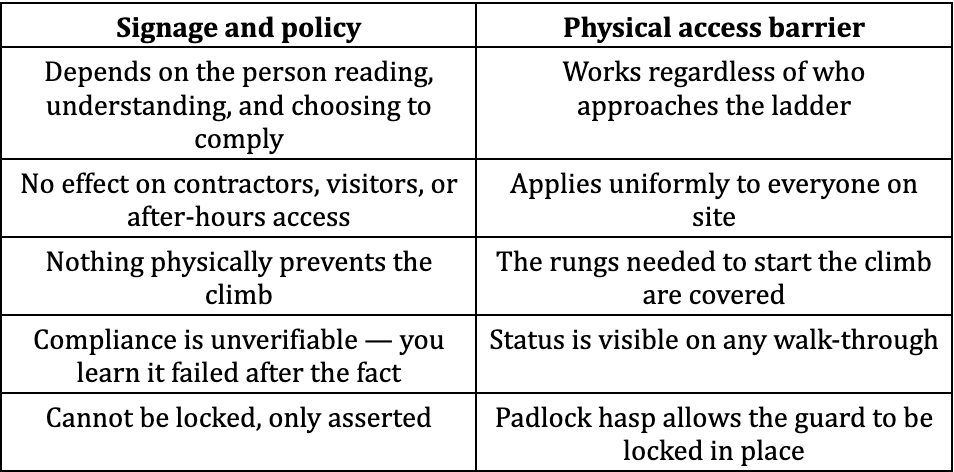
The hierarchy of controls puts physical safeguards above administrative ones because administrative controls depend on human decisions made under time pressure. A barrier does not.
Four questions cover most specifications.
Does the standard size fit? BCG ladder guards measure 15 inches wide by 62 inches high, a standard size that fits most applications. Where a ladder falls outside that, custom sizes are available upon request.
What material suits the environment? Ladder guards are available in mild steel at 29 lbs, stainless steel at 28 lbs, and aluminum at 17 lbs. Stainless suits washdown, chemical exposure, and corrosive environments. Aluminum matters where a single person handles the guard regularly. Mild steel is the general-duty option.
What visibility do you need? Guards are powder coated safety yellow for durability and high visibility, which is the right choice where the barrier should be obvious. They are also available in black or grey where a lower-visibility finish suits the setting.
How will it be secured? A padlock hasp is included to easily lock guards in place and restrict access to unauthorized individuals. Padlocks are available for purchase separately.
Installation is deliberately simple, because a guard that requires a work order and a contractor tends not to get installed. There is no welding or drilling required. The guard hangs on the ladder, the lower hook is adjusted and tightened, and the guard is secured in place using the padlock hasp and supplied hardware. It can be installed or removed in seconds, and built-in handles ensure ease of use and improve ergonomics for whoever is handling it.
That last point is not a convenience feature. A guard that is awkward to remove and reinstall gets left off after authorized access, which returns the ladder to its original unsecured state.
BCG has built guarding for industrial facilities across North America for over 35 years, designed with reference to OSHA, MSHA, and CSA standards.
Start with an inventory rather than a purchase order. Walk your site and list every fixed ladder, then note two things against each one: what is at the top, and who currently can climb it.
Sort that list by what the ladder leads to. A ladder to a lighting fixture is a different exposure than a ladder to a platform above running equipment or into a confined space. The ladders serving the highest-consequence areas are where access control earns its cost first.
Then check the practical details before ordering: ladder width and the height of the section you need covered, the environment the guard will sit in, and whether the guard will be locked or simply barriered. Where a ladder falls outside the standard size, flag it early so custom sizing can be quoted alongside the standard units.
Finally, decide who holds the key and how authorized access is logged. A locked guard with a padlock hanging open on the rail is a barrier in name only.
See the BCG ladder guard range →
Are ladder guards required by OSHA?
No. OSHA’s fixed ladder standard, 29 CFR 1910.23, addresses the design, construction, and condition of the ladder itself. It does not require a barrier restricting who may climb. Ladder guards are an access control measure a facility chooses to install, typically following a risk assessment or an insurer’s recommendation.
Are ladder guards a form of fall protection?
No. Ladder guards restrict access to fixed ladders by unauthorized operators. They are unrelated to fall protection systems, which protect a person who is already climbing or working at height. The two address different hazards and neither substitutes for the other.
Can a ladder guard be installed without welding or drilling?
Yes. BCG ladder guards require no welding or drilling. The guard hangs on the ladder, the lower hook is adjusted and tightened, and it is secured using the supplied hardware. Installation or removal takes seconds.
What size ladder guard do I need?
The standard BCG ladder guard is 15 inches wide by 62 inches high and fits most applications. For ladders outside that range, custom sizes are available upon request.
Can ladder guards be locked?
Yes. A padlock hasp is included with every guard so it can be locked in place, restricting access to unauthorized individuals. Padlocks are available for purchase separately.
What material should we specify?
Mild steel for general duty, stainless steel for washdown or corrosive environments, and aluminum where weight matters for frequent handling. All three are available powder coated safety yellow, and aluminum is also available in black or grey.
Sources

.png)

