.png)

March 7, 2025
Belt Conveyor Guarding Supports Charlee’s Run with $1,500 Donation
Belt Conveyor Guarding proudly donated $1,500 to Charlee’s Run in support of its community initiatives and impact.
Read More


.png)
Belt Conveyor Guarding

September 17, 2026
A guard can be securely in place and appear compliant, yet still fail to protect anyone. Machine guard opening size is one of the two variables that decide whether a guard actually works. The other is how far that guard sits from the moving part behind it. Get either one wrong and a worker can put a finger, a hand, or an arm through the opening and reach the hazard.
This is the failure mode that passes a walk-by inspection. The equipment looks guarded. The guard is present, secure, and in good condition. But the openings are large enough, or the standoff short enough, that the guard is decorative. This guide covers how the two variables work together, what ANSI B11.19, CSA Z432, and ISO 13857 require, and how a maintenance or safety team can check a guard in the field instead of estimating.
Neither variable means anything on its own.
A guard needs openings. Ventilation, visual inspection, material clearance, and cleanout all depend on them. A fully sealed enclosure would trap heat, hide a developing fault, and get removed the first time someone needed to see what was happening behind it.
The question is never whether to have openings. It is how large an opening can be at a given distance from the hazard. The relationship is straightforward: the larger the opening, the farther the guard has to sit from the moving part. A small slot can be close to a rotating shaft because a finger cannot pass far enough through it to reach. A larger square opening admits a whole hand, so the guard has to stand off far enough that an arm at full extension still comes up short.
Every safeguarding standard in North America and internationally encodes that same trade-off. They differ in table format and terminology, not in principle.
The consequences of getting it wrong show up in enforcement data. Machine guarding remained on OSHA’s Top 10 most-cited list in fiscal year 2025, with 1,239 citations issued under the general machine guarding standard, 29 CFR 1910.212 (OSHA, FY2025). In mining, moving machine parts has held the position of most-cited standard in metal and nonmetal operations for years, with 2,897 violations of 30 CFR 56.14107(a) recorded in calendar year 2024 (MSHA). A meaningful share of those findings are not missing guards. They are guards that were present and inadequate.
Three standards govern this question across most of the industrial world, and heavy industry in North America routinely encounters all three.
ANSI B11.19-2019 covers the performance requirements for safeguarding measures on machine tools and industrial machinery in the United States. It sets out how a guard must perform, including the permissible opening sizes at given distances from a hazard.
CSA Z432:23, Safeguarding of Machinery, is the Canadian benchmark. It is risk-based, and Canadian provincial occupational health and safety regulations reference it directly in their machine safeguarding sections. When a regulation references a standard, that standard carries regulatory weight.
ISO 13857-2019 specifies safety distances to prevent hazard zones being reached by upper and lower limbs. It is the international reference point, and it is the standard most often cited when equipment is designed or supplied across borders.
Health and safety legislation varies across sectors and geographies, but it consistently points back to these documents in the sections dealing with equipment guarding. Where such a reference is made, the referenced standard’s requirements apply.
One practical note for cross-border operators: a facility with sites in both countries does not need three separate guarding philosophies. BCG guarding is designed with reference to OSHA, MSHA, and CSA standards, so one specification travels.
The standards publish tables. The plant floor needs something faster.
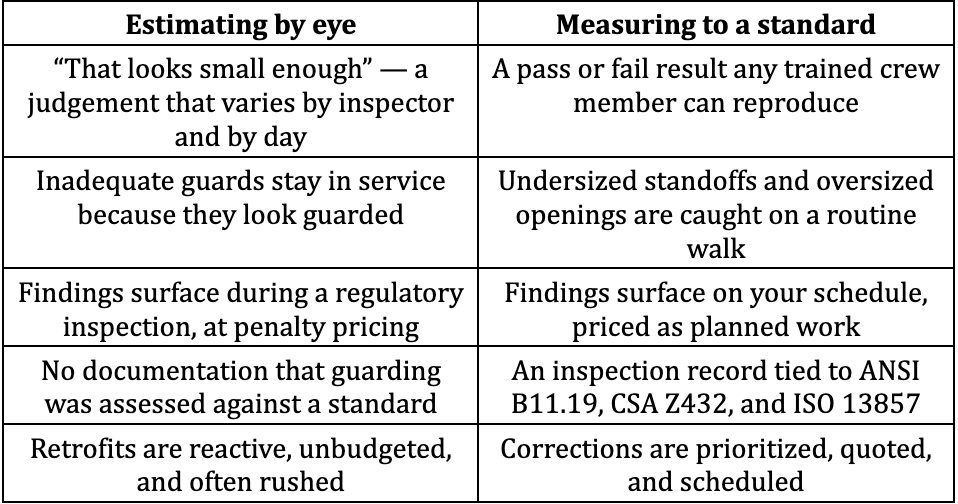
A safety gauge is a physical measuring tool sized to the opening and distance requirements in the standards. Instead of reading a table, measuring an opening with calipers, measuring the standoff, and cross-referencing, an inspector inserts the gauge and reads the result directly.
The BCG Safety Gauge is built to the opening-size and distance requirements set out in ANSI B11.19-2019, CSA Z432:23, and ISO 13857-2019, and features both metric and imperial measurements. Using it is a three-step check:
A failure tells you one of two things is wrong: the opening is too large for the distance, or the guard sits too close to the hazard for the opening. Either finding is actionable, and either one is far cheaper to correct before an inspector or an incident identifies it.
Building this check into a routine guard inspection turns guarding assessment into something repeatable that any trained crew member can perform, rather than a judgement call that varies by who is walking the line that day.
The human cost sits behind the compliance cost. In 2024, 213 workers were killed by being struck, caught, or compressed by running powered equipment, part of 756 deaths from contact with objects and equipment (BLS, Census of Fatal Occupational Injuries, 2024). The equipment in those cases was known. The moving part was reachable. That is precisely what a distance-and-opening check is designed to find.
A failed check has a small number of remedies, and the right one depends on why it failed.
If the opening is too large, the guard needs a different opening pattern — a finer perforation or a narrower slot — while retaining the ventilation, visibility, or cleanout function the opening was there to provide.
If the guard sits too close, moving it outward may resolve the finding, provided the new position does not interfere with operation or maintenance access.
If neither adjustment is workable within the equipment layout, the guard was not designed for the application. A guard adapted from a standard panel to fit equipment it was not made for is the most common source of this failure. A custom fit designed around the machine solves the geometry problem at the source, which is why BCG designs guarding per application rather than supplying stock panels.
Whichever path applies, one principle holds: a guard that is difficult to remove and reinstall will come off during maintenance and stay off. Optional ergonomically friendly handles and removable front guards let a crew service the equipment and put the guard back, saving a significant amount of time and keeping the guard on the machine where it protects someone.
BCG has built guarding for industrial facilities across North America for over 35 years, designed with reference to OSHA, MSHA, and CSA standards.
Start with the guards nobody questions. The ones flagged as missing or damaged are already on someone’s list; the risk sits in the guards that look fine and have never been measured.
Walk your highest-exposure equipment — conveyor drives, couplings, fans, pumps, and any rotating component within reach of a walkway or a routine maintenance position. Check each guard’s openings against the distance to the hazard using a safety gauge rather than judgement. Record what passes and what fails, then sort the failures by exposure: the pinch points closest to where people actually stand and work come first.
Add the check to your existing guard inspection routine so it happens on a schedule rather than after an event. A guard that passed last year may not pass today if it has been modified, relocated, or replaced with something that fit the bolt pattern rather than the machine.
Request your free BCG Safety Gauge →
_______________________________________________________________________________________________________
How big can an opening in a machine guard be?
It depends entirely on how far the guard sits from the hazard. There is no single permissible opening size. The larger the opening, the greater the required distance between the guard and the moving part, because a larger opening admits more of a hand or arm. ANSI B11.19-2019, CSA Z432:23, and ISO 13857-2019 each publish the relationship between opening size and required safe distance.
What is the safe distance for machine guarding?
Safe distance is the minimum clearance between a guard and the hazard behind it, set so that a limb passing through an opening in the guard cannot reach the moving part. Like opening size, it is not a single figure — it is determined by the size and shape of the openings in the guard.
Do Canadian facilities follow ANSI or CSA for machine guarding?
CSA Z432:23 is the Canadian benchmark, referenced by provincial occupational health and safety regulations. ANSI B11.19-2019 applies in the United States. Operators with facilities on both sides of the border commonly specify guarding designed with reference to OSHA, MSHA, and CSA standards so that one approach satisfies every site.
Is a rectangular opening measured by its long side or its short side?
The short side. A rectangular slot is governed by its narrow dimension, because that dimension determines what can pass through it. This is why a safety gauge must be oriented with the short side of the opening to give a correct reading.
How do I get a safety gauge for our inspection process?
BCG provides the Safety Gauge free of charge. It can be requested from the resources section of the BCG website, and it features both metric and imperial measurements for use across mixed equipment fleets.
Sources

.png)

