Machine Guarding Requirements for Heavy Industry: OSHA, MSHA, and CSA Compliance Explained
Belt Conveyor Guarding
August 24, 2026
Every year, machine guarding lands near the top of OSHA’s most-cited standards — and every year, workers in heavy industry are injured on the same rotating equipment the rules were written to cover. Meeting machine guarding requirements is not a paperwork exercise. It is the difference between a guarded pinch point and an amputation, and between a clean inspection and a five-figure penalty.
This guide is built for safety, maintenance, and plant managers in mining, steel, cement, power generation, and pulp and paper. It covers what OSHA, MSHA, and CSA each require, the guard types that satisfy those rules, and the practical problem every facility faces: keeping guards on the equipment between inspections.
Why Do Machine Guarding Requirements Matter So Much in Heavy Industry?
Machine guarding is not a fringe citation. In fiscal year 2024, OSHA wrote 1,541 violations of its general machine guarding standard, 29 CFR 1910.212 — enough to rank it ninth on OSHA’s Top 10 most-cited list, with manufacturing accounting for 80% of those citations (OSHA, FY2024). Add lockout/tagout, the standard immediately above it, and the two together drew more than 3,500 written violations in a single year.
The human numbers are worse. In 2024, 213 workers were killed by being struck, caught, or compressed by running powered equipment, part of 756 deaths from contact with objects and equipment (BLS, Census of Fatal Occupational Injuries, 2024). Heavy industry runs on exactly the machinery behind those figures: conveyors, crushers, drives, couplings, and fans that do not stop for a shortcut.
What Does OSHA Require for Machine Guarding?
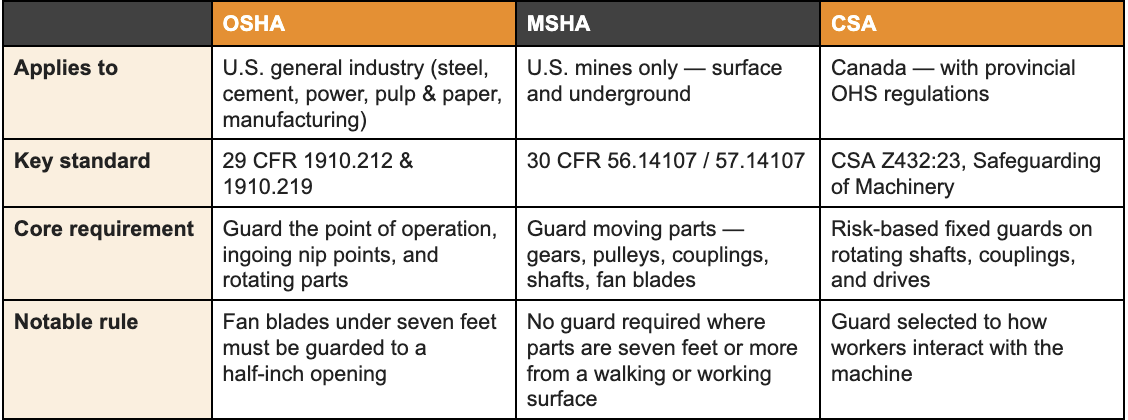
OSHA’s core rule, 29 CFR 1910.212, is a performance standard: one or more methods of guarding must protect operators and other workers from hazards such as ingoing nip points, rotating parts, and the point of operation. A companion standard, 29 CFR 1910.219, covers mechanical power-transmission apparatus — belts, pulleys, sheaves, shafts, and couplings.
Whatever method you choose, OSHA says the guard must meet a few non-negotiable conditions:
Prevent contact with the moving part
Be secured in place and not easily removed or tampered with
Create no new hazard of its own
Allow lubrication and routine service without removing the guard, wherever possible
Not interfere with the machine’s operation
Conveyors carry their own specific expectations under these standards — from head and tail pulleys to return idlers — which is a topic worth reading on its own.
How Do MSHA and CSA Requirements Differ from OSHA?
Heavy industry rarely lives under a single regulator. A mining company may answer to MSHA in the United States and to a provincial ministry plus CSA in Canada, while its general-industry sites fall under OSHA. The principle is identical across all three — keep the worker out of the moving part — but the citations and the wording differ.
MSHA’s moving-machine-parts standard, 30 CFR 56.14107 (surface) and 57.14107 (underground), requires that gears, sprockets, chains, drive, head, tail, and take-up pulleys, flywheels, couplings, shafts, and fan blades be guarded, unless those parts are seven feet or more from a walking or working surface. In Canada, machine safeguarding is regulated provincially and measured against CSA Z432, Safeguarding of Machinery, updated in 2023. MSHA applies to U.S. mining only; it does not govern Canadian mines.
This is where a single-supplier approach earns its keep. BCG guarding is designed with reference to OSHA, MSHA, and CSA standards, so a facility operating on either side of the border works from one consistent guarding approach. While parts of this guide reference Canadian requirements, the strategy applies broadly to operators across North America.
What Types of Machine Guards Meet These Requirements?
OSHA recognizes four types of guards, and each fits a different hazard and workflow:
Fixed guards — a permanent barrier bolted or welded over the hazard; the most common and most reliable for rotating equipment
Interlocked guards — shut the machine down automatically when the guard is opened or removed
Adjustable guards — a fixed barrier that can be set for different stock or configurations
Self-adjusting guards — move with the material, opening only as far as the workpiece requires
For the conveyors, couplings, and drives that dominate heavy industry, fixed guards do most of the work — provided they are specified to the machine and easy enough to service that they stay on. The full range of guard types and where each one fits is worth a closer look.
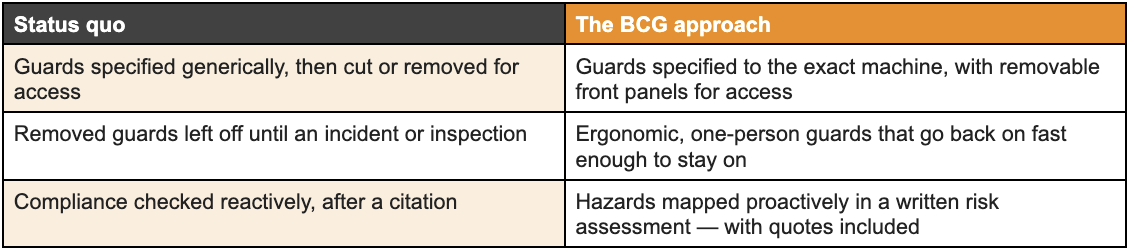
Most guarding failures are not design failures — they are maintenance failures. A guard gets removed for a quick task and never goes back on, because it was awkward, heavy, or slow to handle. The standards do not care why it came off; an unguarded machine is a citation and a hazard whether the guard is missing or simply set aside.
The fix is guarding built for how maintenance actually works. Return idler guards designed for one-person handling — the heaviest 24-inch model comes in under 50 lbs, with large openings for inspection and no welding or cutting to install — go back on fast. Optional ergonomically friendly handles and removable front guards let a crew service the equipment without taking the guard off the machine, saving a significant amount of time during routine maintenance. Custom sizes are available upon request, because a guard specified to the exact frame leaves no gap for a hand to reach through.
BCG has built guarding for heavy-industry facilities across North America for over 35 years — designed with reference to OSHA, MSHA, and CSA standards.
Frequently Asked Questions
Is machine guarding an OSHA requirement?
Yes. Under 29 CFR 1910.212, employers must guard machine hazards such as the point of operation, ingoing nip points, and rotating parts. It is one of OSHA’s most frequently cited standards, ranking ninth on the FY2024 Top 10 with 1,541 violations.
Does OSHA or MSHA apply to my facility?
It depends on the operation. OSHA covers U.S. general industry — steel, cement, power, pulp and paper, and manufacturing. MSHA covers U.S. mines only. In Canada, machine safeguarding is regulated provincially and measured against CSA Z432. A company with mixed operations can fall under more than one, which is why BCG guarding is designed with reference to all three.
What are the four types of machine guards OSHA recognizes?
Fixed, interlocked, adjustable, and self-adjusting. Fixed guards — a permanent barrier over the hazard — are the most common choice for rotating equipment like conveyors, couplings, and drives.
How far from a hazard do you have to be before a guard is not required?
Under MSHA’s moving-machine-parts standard, guarding is not required where the exposed parts are seven feet or more from a walking or working surface. OSHA applies a similar logic to specific hazards — for example, fan blades less than seven feet above the floor must be guarded. Distance is a last resort, not a strategy; most heavy-industry hazards are well within reach.
Actionable Next Steps
Start by matching your facility to the right standard — OSHA, MSHA, CSA, or a combination — and inventory the rotating equipment each one covers: conveyors, couplings, shafts, sheaves, fans, and drives. Flag any guard that is missing, damaged, or routinely removed and left off, and prioritize the pinch points closest to walkways, cleanup points, and daily maintenance tasks.
If mapping those gaps in-house is a stretch, a structured assessment does it for you. A BCG safety risk assessment identifies the exposed hazards across your site and hands you a prioritized plan with guarding quotes included, so budgeting is straightforward.


.png)

.png)


.png)

