Potash Mine Conveyor Guarding: A Saskatchewan Operator’s Guide
Belt Conveyor Guarding
August 18, 2026
A potash mine runs on its conveyors. Ore moves from the shaft to the mill to load-out on kilometres of belt, and every drive, pulley, and idler along that path is a rotating hazard. Potash mine conveyor guarding is what keeps a worker’s hand out of those pinch points during the routine tasks — cleanup, inspection, clearing a jam — where most contact injuries actually happen.
For Saskatchewan operators, the stakes are unusually high. The province mines roughly a third of the world’s potash, and that output depends on conveyor systems running around the clock. When a guard is missing, or has been removed and left off, the exposure is immediate: a serious injury, a regulatory finding, and a stopped line. This guide covers what to guard, what Canadian regulations expect, and how to keep guarding on the equipment long enough to matter.
Why Is Conveyor Guarding Such a High-Stakes Issue in Potash Mining?
Saskatchewan is the largest potash-producing region on earth. The province produced a record 15.1 million tonnes of potash (K2O) in 2024, an 8% increase over 2023, and accounts for more than 90% of all Canadian production (Government of Saskatchewan). Canada supplied 79% of U.S. potash imports in 2025 — this is critical infrastructure, and it is expanding. BHP’s Jansen mine is projected to lift Canadian production capacity by roughly 40% once fully operational.
More output means more belt, more transfer points, and more hours of exposure. Nationally, 213 workers were killed in 2024 by being struck, caught, or compressed by running powered equipment — part of 756 deaths from contact with objects and equipment (BLS, Census of Fatal Occupational Injuries, 2024). Conveyor entanglement is a recurring contributor to that count, and it concentrates in exactly the hands-on tasks a potash operation performs every shift.
Which Rotating and Conveyor Components Put Potash Workers at Risk?
The hazards on a potash line are predictable, which is precisely why they are guardable. The components that most often put a worker in a pinch point include:
Return idlers, which sit low near walkways and cleanup points
Head, tail, and take-up pulleys, where the belt wraps and creates a nip
Drive couplings and motor shafts on conveyor drives
Screen, crusher, and feeder drives at transfer points
Proper guarding does three things, and BCG frames them plainly: it prevents access to moving belt and roller pinch points, reduces the risk of entanglement, and keeps inspection and maintenance access workable so guards stay on between shifts.
What Do Canadian Regulations Require for Potash Mine Conveyor Guarding?
In Canada, machine safeguarding is regulated provincially. In Saskatchewan, The Mines Regulations, 2018 require that dangerous moving parts of machinery be guarded to prevent contact, and general industrial workplaces follow The Occupational Health and Safety Regulations, 2020. Both point to the national benchmark: CSA Z432, Safeguarding of Machinery, updated in 2023, which calls for fixed guards on rotating shafts, couplings, sprockets, and belt-and-pulley drives, selected to how workers actually interact with the machine during operation and maintenance.
One misconception is worth clearing up: MSHA does not apply to Saskatchewan potash mines. MSHA is a U.S. standard covering U.S. mining only. Canadian operations answer to provincial regulators and CSA. BCG guarding is designed with reference to OSHA, MSHA, and CSA standards, so a company with facilities on both sides of the border works from one consistent approach. While this guide focuses on Saskatchewan requirements, the guarding strategy applies broadly to operators across North America.
Reactive vs. Proactive Guarding: What Does Waiting Actually Cost?
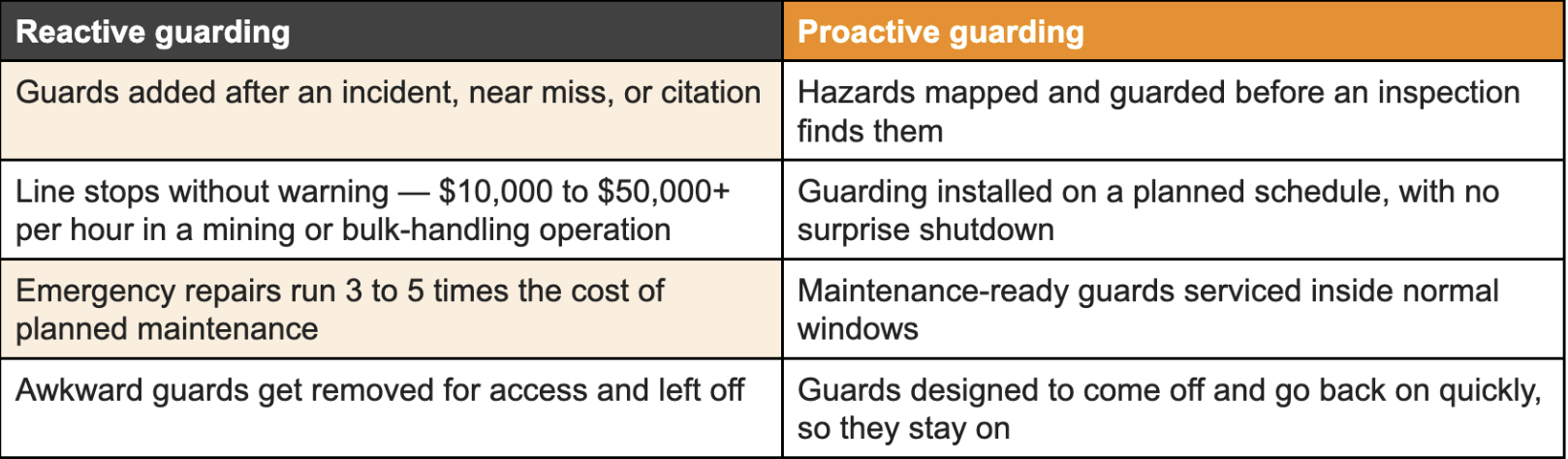
Many facilities guard reactively after an incident, an inspection finding, or a near miss. The math argues for the opposite.
An unplanned conveyor shutdown in mining and bulk-material handling runs from $10,000 to more than $50,000 per hour, depending on throughput and product value (industry estimates, 2025), and repairs made under pressure typically cost three to five times more than planned maintenance. Proactive guarding is not only safer — it protects uptime.
How Do You Keep Guards On Between Shifts?
A guard only protects a worker when it is on the machine. The most common failure is a guard removed for a quick task and never reinstalled — because it was awkward, heavy, or slow to handle. BCG designs against that failure at the product level.
Return idler guards are designed to be user friendly. They have tapered slots to reduce material build up and side panels that hinge open for easy maintenance. No welding or cutting to install. Return Idler Guards can be custom designed for unique applications.
BCG has built guarding for mining and industrial facilities across North America for over 35 years, designed with reference to OSHA, MSHA, and CSA standards.
Frequently Asked Questions
Are potash mines in Saskatchewan regulated by MSHA?
No. MSHA is a U.S. standard that covers U.S. mining operations only. Saskatchewan potash mines are regulated provincially under The Mines Regulations, 2018, supported by CSA Z432 for machine safeguarding. BCG designs guarding with reference to OSHA, MSHA, and CSA so operators with facilities on both sides of the border work from one standard.
Which conveyor components must be guarded in a potash operation?
Drive, head, tail, and take-up pulleys, return idlers, drive couplings, and the screen and crusher drives at transfer points are the moving parts most likely to cause injury. Guarding should prevent access to these pinch points while still allowing inspection and maintenance access.
Does a BCG safety risk assessment include New Guarding pricing?
Yes. A BCG assessment identifies the guarding gaps across your conveyors, rotating equipment, and access points, and includes the guarding quotes — so you leave with a prioritized plan and the numbers to budget it.
Actionable Next Steps
Start with the equipment that carries the most risk and the most tonnes. Walk your conveyor lines and note every exposed return idler, pulley, coupling, and transfer-point drive. Confirm your guarding against CSA Z432 and The Mines Regulations, 2018, and flag any guard that is missing, damaged, or routinely removed and left off. Then prioritize by exposure — the pinch points closest to walkways, cleanup points, and daily maintenance tasks come first.
If mapping those gaps in-house is a stretch, a structured assessment does it for you. A BCG safety risk assessment identifies the exposed hazards across your site and hands you a prioritized plan with guarding quotes included, so budgeting is straightforward.


.png)

.png)


.png)

