.png)

March 7, 2025
Belt Conveyor Guarding Supports Charlee’s Run with $1,500 Donation
Belt Conveyor Guarding proudly donated $1,500 to Charlee’s Run in support of its community initiatives and impact.
Read More


.png)
Belt Conveyor Guarding

July 8, 2026
Cement and aggregate plants run on rotating equipment that does not stop for a maintenance shortcut. Grinding mills, conveyor drives, return idlers, and drive couplings put workers within reach of high-energy pinch points on every shift.
In 2025, MSHA recorded 33 miner fatalities. Powered haulage — the category that includes belt conveyors — was the leading cause, with 13 deaths, and six more miners died in machinery accidents (MSHA, 2025). Cement and aggregate operations sit squarely inside that data. These are MSHA-regulated sites, and their rotating equipment shows up in the fatality and citation record year after year.
The hazards in a cement or aggregate plant are predictable — which is exactly why they are guardable.
Here is where these plants are most exposed, what the standards require, and how to find your shortcomings before an inspector does..
The equipment is large, the environment is abrasive, and the maintenance never stops.
A cement or aggregate plant is a continuous-duty environment. Grinding mills, crushers, screens, and long conveyor runs operate around the clock, and the dust and grit that come with the product wear on everything — guards included.
That creates two problems. First, the rotating equipment is everywhere: drive couplings, head and tail pulleys, return idlers, and v-belt drives on auxiliary equipment. Second, the constant maintenance means guards come off often — and a guard that is awkward to reinstall tends to stay off once the work is done.
Most U.S. cement plants and aggregate operations are regulated by MSHA, not OSHA, which means the guarding expectations — and the inspectors — are different from a general manufacturing floor.
For most cement and aggregate operations in the U.S., MSHA sets the rule.
Under MSHA’s moving machine parts standard (30 CFR 56.14107 and 57.14107), moving conveyor and drive components — head, tail, drive, and take up pulleys, couplings, and shafts — that can cause injury must be guarded to prevent contact. The guard has to stay in place during operation.
For any portion of a facility that falls under OSHA, the general industry machine guarding standard, 29 CFR 1910.212, sets the same expectation: rotating parts and ingoing nip points must be guarded. Canadian operations follow CSA standards.
BCG designs conveyor and rotating-equipment guarding with reference to OSHA, MSHA, and CSA standards — so a guarding decision holds up whichever inspector walks the site.
MSHA recorded 33 miner fatalities in 2025, with powered haulage — the category that includes belt conveyors — the leading cause at 13.
Source: MSHA, 2025
It is rarely the obvious guard that is missing. It is the coupling no one thinks about.
The hazards that cause incidents in cement and aggregate plants are consistent, and most are guardable with the right design:
Proper guarding for these hazards does three things: it prevents access to moving pinch points, it reduces the risk of entanglement, and it keeps inspection and maintenance access workable so guards are not removed and left off.
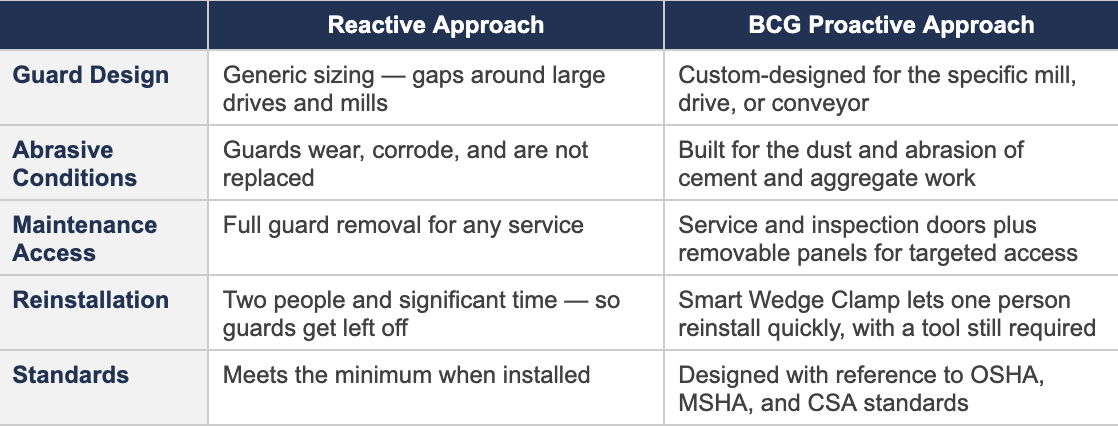
Use this as a prompt for a physical walkthrough. A document review will not catch a coupling guard that was removed for service and never put back.
Are cement plants regulated by OSHA or MSHA?
Most cement plants and aggregate operations in the U.S. fall under MSHA jurisdiction, including crushing, grinding, and conveying. Some downstream processing can fall under OSHA. Canadian operations follow CSA standards. BCG guarding is designed with reference to all three for cross-border coverage.
What does MSHA require for conveyor guarding?
Under MSHA’s moving machine parts standard, 30 CFR 56.14107 and 57.14107, moving conveyor and drive components that can cause injury must be guarded to prevent contact, and the guard must stay in place during operation.
What are the most common guarding gaps in cement and aggregate plants?
Drive couplings, conveyor tail pulleys, and return idlers are the most frequently overlooked. They are often left exposed after maintenance because the guard was awkward or slow to reinstall.
Can guarding survive cement-plant dust and abrasion?
Yes, when it is built for the conditions. BCG guards are custom-designed for the specific equipment and the abrasive environment, rather than fitted from a generic size range.
How do we find our gaps?
Start with a guarding risk assessment. It maps the exposed rotating hazards across your conveyors, drives, and access points so your guarding decisions are based on your plant, not a generic checklist.
BCG has been building guarding for cement, aggregate, and mining operations across North America for over 35 years.
safety@conveyorguarding.com · +1 (866) 300-6668 · conveyorguarding.com
Start with a risk assessment → conveyorguarding.com/resources#assessment
While this blog highlights cement and aggregate operations, the hazards and guarding strategies discussed apply broadly to facilities across North America — both U.S. and Canadian operations.
SOURCES
[1] MSHA — Moving Machine Parts, 30 CFR 56.14107 / 57.14107. msha.gov
[2] MSHA — 2025 mining fatality data (33 fatalities; powered haulage leading cause, 13). msha.gov · Pit & Quarry, Jan 2026
[3] OSHA — Machine Guarding, 29 CFR 1910.212. osha.gov/laws-regs/regulations/standardnumber/1910/1910.212
[4] CSA — Z432 Safeguarding of Machinery. csagroup.org

.png)

