Fixed Ladder Access Control: Keeping Unauthorized Climbers Off Your Elevated Equipment
Belt Conveyor Guarding
November 12, 2026
A fixed ladder with nothing at its base is an open door to every elevated area it reaches: the mezzanine, the roof, and the platform above a running conveyor. Anyone on the floor can climb it: a new hire taking a shortcut, a contractor who wandered off route, a visitor looking for a better view. Most facilities guard the equipment at the top and never ask who can reach it. Fixed ladder access control closes that gap, not by changing how your authorized team works, but by keeping everyone else off the ladder in the first place.
That distinction matters, because the cost of getting it wrong is real. A single serious machine-related injury can cost a facility more than a full year of guarding, and studies on safety investment put the return at roughly $4 to $6 for every $1 spent. Controlling access is one of the lowest-cost ways to lower that exposure.
What is fixed ladder access control?
Access control means deciding who can climb a fixed ladder, and physically enforcing that decision.
It is a barrier at the base or landing of a fixed ladder: a lockable gate, cover, or guard that stops unauthorized or untrained people from using it. Authorized personnel open it and go about their work; everyone else is stopped before the first rung. The goal is restriction, not protection during the climb. BCG AccessGuard ladder guards are built for exactly this: controlled-access barriers specified to your ladder, with custom sizes available upon request.
Why does uncontrolled ladder access create liability?
Every person who can reach a high-risk area without authorization is an exposure you own.
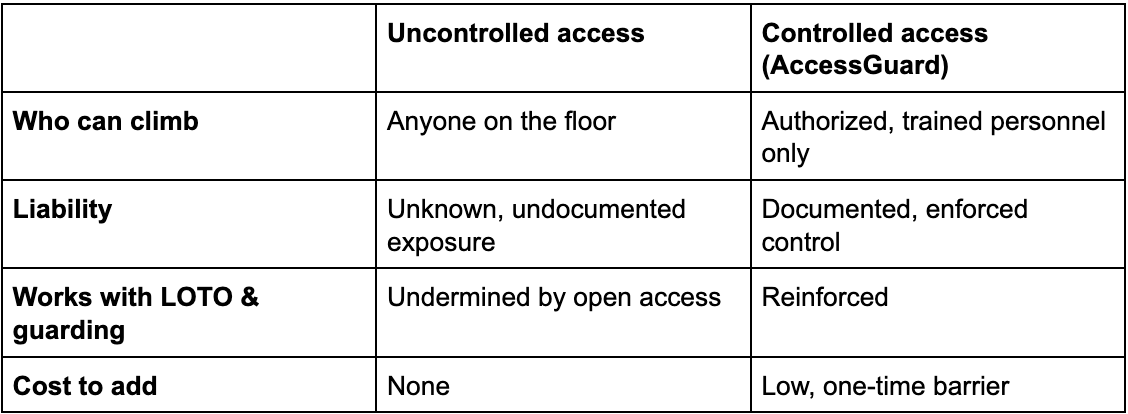
When access is open, you cannot say who was where, or stop the climb that should never have happened. An uncontrolled ladder also undermines your other controls: lockout/tagout and machine guarding both assume that only trained people are near the equipment. Restrict who can get up there, and every one of those controls gets stronger. Leave it open, and a single unauthorized climb can erase them.
How is access control different from fall protection?
Ladder guards control access. They are not fall protection equipment, and the two should never be confused.
Fall protection, including cages, ladder safety systems, and personal fall arrest, protects a person while they climb. Access control decides whether an unauthorized person climbs at all. OSHA regulates fixed ladders and safe access to walking-working surfaces under 29 CFR 1910.23 and 1910.28; those rules govern how people are protected when they do climb. Controlling who climbs is a separate, complementary decision, driven by liability and site security. A ladder guard is not mandated by those standards and is not a substitute for them. It is an access-control layer you choose to add on top.
What should a fixed ladder access guard do?
A good access guard restricts entry, survives the plant floor, and fits the ladder it protects.
Look for three things. First, it should restrict access to authorized, trained personnel; a lockable barrier beats signage every time. Second, it should be built for the environment: industrial steel that holds up to daily plant use. Third, it should be specified to the ladder rather than forced from a generic size, because a barrier that does not fit leaves the very opening it is meant to close. BCG designs ladder guards to your equipment, with custom sizes available upon request.
Uncontrolled access vs. controlled access
Actionable insights: next steps
Walk your facility and list every fixed ladder and who can currently reach it. Flag the ladders that lead to high-risk or restricted areas: mezzanines over moving equipment, roof access, and confined machinery spaces. Then add controlled-access guarding where access should be limited to authorized personnel. You will reduce liability without touching how your trained team does its job.
No. OSHA does not mandate a ladder guard. The fixed-ladder rules in 29 CFR 1910.23 address fall protection for people who climb; controlling who may climb is a separate measure facilities add to reduce liability and restrict access to authorized personnel.
Is a ladder guard the same as a ladder cage?
No. A cage is fall-protection hardware around the ladder. A ladder guard is an access-control barrier at the base that restricts who can climb. They solve different problems, and one does not replace the other.
Who should be allowed to use a fixed ladder?
Only authorized, trained personnel whose job requires access to the elevated area. A ladder guard lets you enforce that instead of relying on signage alone.
Can ladder guards be made to fit our ladders?
Yes. BCG specifies ladder guards to your equipment, with custom sizes available upon request.
Sources: OSHA 29 CFR 1910.23 (Fixed ladders) and 1910.28 (Walking-working surfaces); OSHA “Safety Pays” / Liberty Mutual Workplace Safety Index (return on safety investment). All guarding designed with reference to OSHA, MSHA, and CSA standards.