What OSHA Really Requires for Machine Guarding — and Why Violations Keep Happening
Belt Conveyor Guarding
June 11, 2026
Machine guarding has ranked in OSHA's Top 10 Most Cited Violations every year since 2018. In FY2024, there were 1,541 recorded violations under 29 CFR 1910.212. It is still in the top 10 for FY2025 and FY2026.
The same hazards appear in the data year after year: exposed rotating shafts, unguarded couplings, belt and roller pinch points.
The pattern is not a knowledge gap. Most facilities know what the standard requires. The problem is that guards come off — for maintenance, for access, for any number of operational reasons — and they don't go back on.
Here's what the standard actually says, why violations keep recurring, and what properly designed guarding does about it.
What Does OSHA Require for Machine Guarding?
The requirement is straightforward. If a moving part can injure someone, it needs a guard.
OSHA 29 CFR 1910.212 applies across general industry — manufacturing plants, industrial facilities, warehouses, and construction sites. The core requirement is that all machinery capable of causing injury must be guarded.
The hazard zones the standard covers include rotating shafts and couplings, belt and pulley nip points, pinch points where a moving part comes close to a fixed surface, and points of operation where work is performed on material.
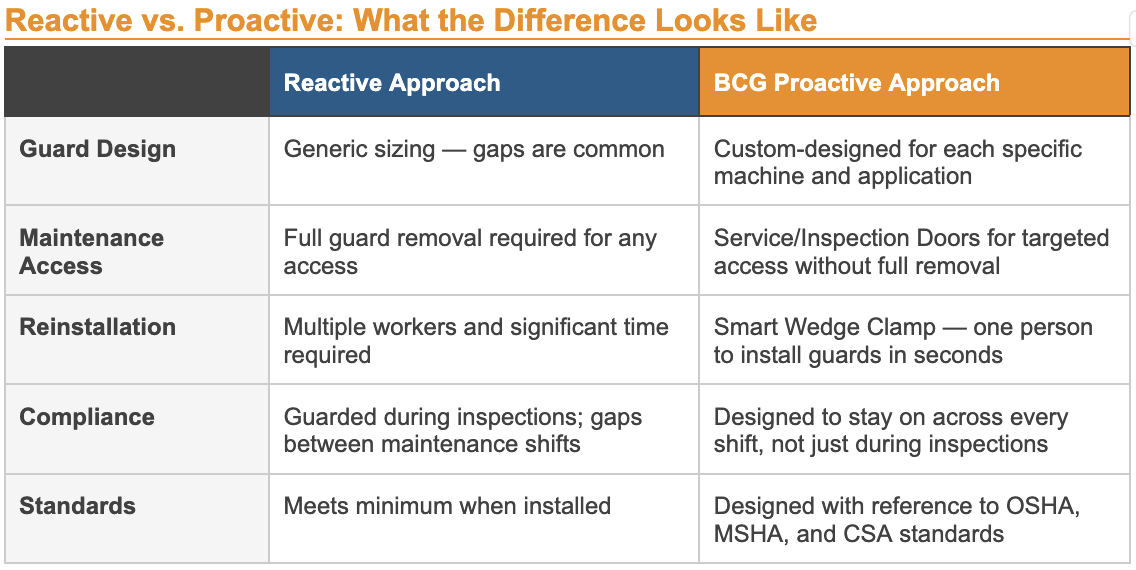
One thing that often catches facilities off guard: the standard requires that guards cannot be removed without a tool. A guard that can be lifted off by hand does not meet the requirement — regardless of how well it fits. BCG's Smart Wedge Clamp keeps that tool requirement in place while making the process faster. One person cuts the cable tie with a tool in seconds. Compliance is maintained. Access is easier.
For Canadian facilities, CSA standards apply. BCG guarding is designed with reference to OSHA, MSHA, and CSA standards for facilities operating across both countries.
Why Do Machine Guarding Violations Keep Happening?
It's not that facilities don't know the rule. It's that the guard is difficult to put back.
Here is the scenario that drives most machine guarding violations: a maintenance crew removes a guard to access a drive component or coupling. The work gets done. The shift ends. The next crew arrives. Production resumes. The guard stays off.
It is not carelessness. When reinstalling a guard takes significant time — or requires two people, or there is nowhere obvious to hang it when it comes off — it competes with production pressure and production wins.
The solution is not stricter enforcement. It is guarding designed so one person can reinstall it quickly, without the process becoming a reason to skip it.
A quick note on removed guards: a guard sitting on the floor is not just a compliance issue. It is a tripping hazard. When a guard comes off, it should be hung on the next guard or on adjacent equipment — not set down and left.
Walk your equipment, not just your records. A physical walkthrough of every area with rotating equipment tells you more than a document review. Look for what is missing, not just what is present.
1,541 machine guarding violations were recorded under 29 CFR 1910.212 in FY2024. Machine guarding has remained in OSHA's Top 10 Most Cited Violations in FY2025 and FY2026.Source: OSHA, Top 10 Most Cited Standards FY2024
What Does Proper Machine Guarding Actually Do?
It's not just about having a guard in place. It's about having one that stays there.
Properly designed machine guarding does three things for an industrial facility:
Prevents access to moving belt and roller pinch points — a physical barrier between a worker and the rotating hazard.
Reduces the risk of entanglement — by enclosing drive pulleys, rotating shafts, couplings, and other rotating components.
Improves inspection and maintenance access — so guards stay on between maintenance cycles, not just during inspections.
That last point matters more than it gets credit for. A guard that is difficult to work around gets removed. A guard designed for real maintenance workflows stays on.
BCG guarding products include optional ergonomically friendly handles, removable front guards, and Smart Wedge Clamps, designed to allow one person to manage the guard quickly and efficiently, while still requiring a tool for removal to maintain compliance. That's not a convenience feature. That's what keeps the guard in place.
What to Do Now
Use this as a prompt for a physical walkthrough. Document reviews don't catch guards that are missing, damaged, or never reinstalled.
Walk every area with rotating equipment. Check shafts, couplings, belt drives, and pulley interfaces physically. Document what is guarded, what is damaged, and what is absent.
Ask why guards aren't being reinstalled. If the answer is time or difficulty, the problem is design. That's a solvable problem.
Verify that guards require a tool for removal. If a guard can be removed by hand, it does not meet the OSHA or CSA requirement.
Check guard condition, not just guard presence. Bent or structurally compromised guards are citable even when they are physically in place.
Look at guards near walkways and travelways. This is a consistently cited category in both OSHA, & MSHA inspection records.
Frequently Asked Questions
What is OSHA's machine guarding standard?
29 CFR 1910.212 requires that all machinery capable of causing injury be guarded in general industry environments. The standard covers rotating parts, pinch points, points of operation, and nip points. Guards must be secured and must require a tool for removal. Machine guarding has remained in OSHA's Top 10 Most Cited Violations through FY2024, FY2025, and FY2026.
Does the standard apply to mining operations?
OSHA's machine guarding standard applies to general industry, manufacturing, facilities, and construction. For U.S. mining operations, MSHA regulations apply. For Canadian facilities, CSA standards apply. BCG guarding is designed with reference to all three for cross-border coverage.
Why do machine guarding violations keep happening if the standard is well known?
The most common cause is a design problem, not an awareness problem. Guards that are difficult or time-consuming to reinstall after maintenance get left off. BCG products address this directly — Smart Wedge Clamps, ergonomic handles, and removable front guards allow one person to reinstall a guard in seconds, while the tool-for-removal requirement stays in place.
Does a guard need a tool to be removed in order to meet the OSHA standard?
Yes. Under OSHA 29 CFR 1910.212, guards must not be removable by hand. A guard that can be lifted off without a tool does not meet the requirement. BCG's Smart Wedge Clamp maintains this — a tool is still required to cut the cable tie securing the clamp. The clamp makes the process faster. The compliance requirement stays.
What is the penalty for a machine guarding violation?
OSHA's maximum penalty for a serious violation is $16,550 per citation in 2025. Willful or repeat violations carry penalties up to $165,514 per violation. These figures increase annually with inflation and do not include any costs from injury, liability, or operational disruption.
BCG has been building maintenance-friendly guarding for industrial facilities across North America for over 35 years. safety@conveyorguarding.com · +1 (866) 300-6668 · conveyorguarding.com
SOURCES:
[1] OSHA — Top 10 Most Cited Standards, FY2024. osha.gov/top10citedstandards


.png)

.png)


.png)

